
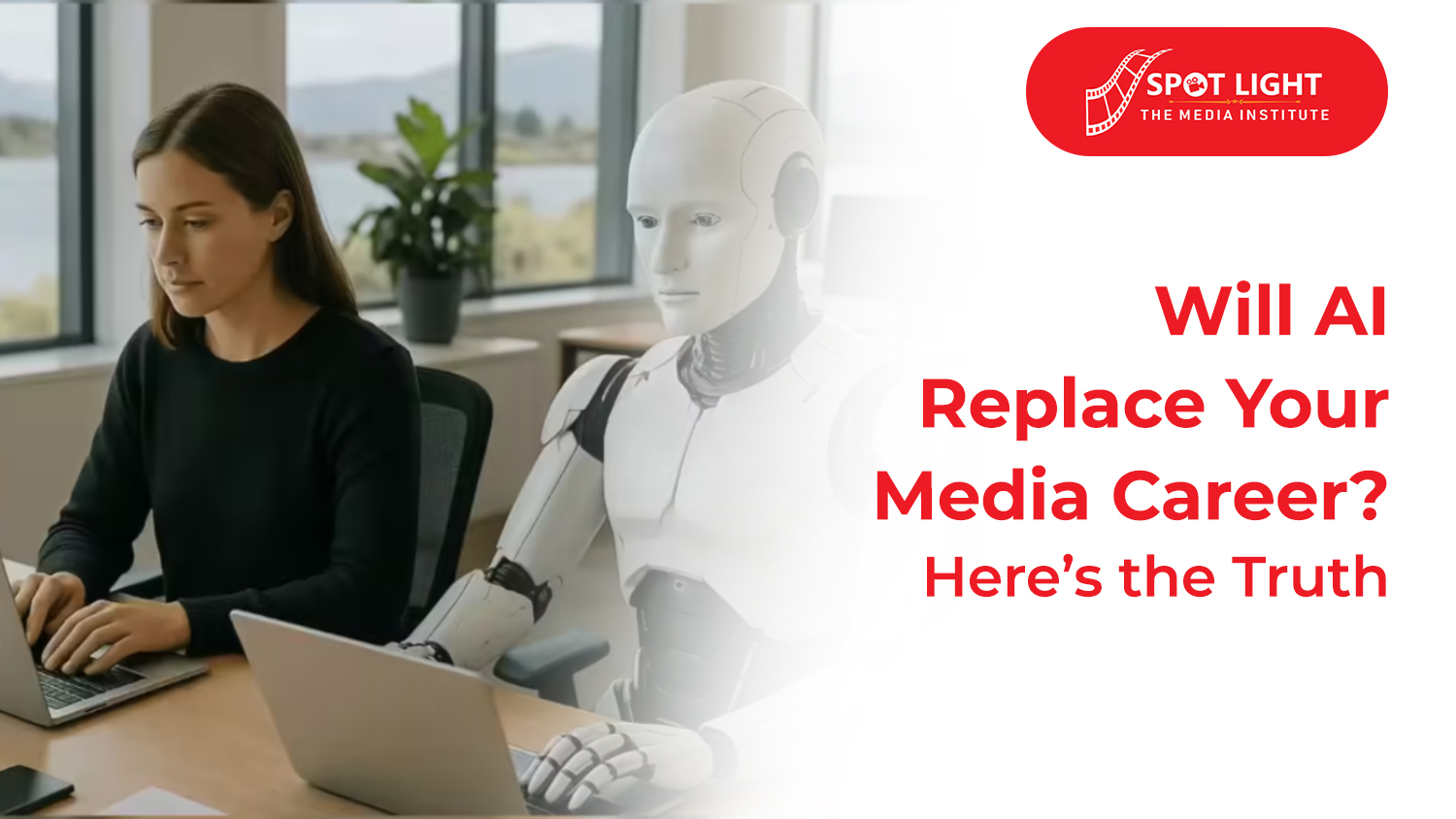
Will AI Replace Your Media Career? Here’s the Truth
Spoiler: it’s not as scary as Twitter makes it sound, but it’s not a joke either.
Every few months, a new headline drops and half the media industry collectively panics: “AI writes better than journalists now.” Or “ChatGPT just replaced your entire content team.” People screenshot it, repost it with three fire emojis, and then… go back to doing their jobs. Because guess what? The jobs are still there.
But here’s the thing — ignoring AI completely is just as naive as catastrophizing about it. The truth, as always, lives somewhere in the uncomfortable middle.
What AI is actually doing in media right now
AI isn’t some future threat knocking on the door. It’s already inside the building, making tea, and occasionally breaking the printer. News organizations use it to auto-generate sports scores and earnings reports. Streaming platforms use it to write metadata descriptions. Ad agencies use it to produce a hundred variations of the same copy in ten minutes.
The jobs AI replaces aren’t really “media careers” — they’re the mechanical, repeatable parts of media jobs. The stuff that bored you anyway.
This is the distinction most people miss. AI doesn’t replace a journalist — it replaces the three hours a journalist spent reformatting press releases. It doesn’t replace a video editor — it replaces the part where they sat cutting silences at 2 AM. That frees up the actual human to do the actual human work.
So who really needs to worry?
Let’s not sugarcoat this. If your primary value is producing content that’s generic, templates, or purely informational — AI is coming for that work. Think: basic product descriptions, boilerplate articles, simple explainer videos. Not because AI is “better,” but because it’s faster and cheaper at that specific thing.
But here’s what AI cannot do, no matter how good it gets. It can’t build trust with a source who’s been burned before. It can’t sit across from a grieving family and ask the right question with the right silence. It can’t feel the room at a press conference and know that the follow-up is the story. It can’t develop a point of view from lived experience. And it absolutely cannot cultivate a personal brand that people actually want to follow.
The skills that make you AI-proof
Here’s a useful mental model: if your work requires empathy, context, or judgment — AI struggles. If it requires storytelling with a genuine human voice — AI produces something that looks like it but feels hollow to anyone paying attention. Focus on building these:
|
Investigative depth |
AI can aggregate. It can’t investigate. Source relationships and original reporting are entirely yours. |
|
On-camera presence |
People follow people. Your face, your voice, your delivery — that’s a moat AI can’t swim across. |
|
Cultural fluency |
Understanding what resonates with a specific audience, right now — that takes instinct AI doesn’t have. |
|
Creative direction |
Using AI as a tool — not being replaced by it — is itself a skill. Learn to direct it like a junior team member. |
The media professionals who are thriving
The people winning in this climate aren’t the ones ignoring AI, and they’re definitely not the ones paralyzed by existential dread on LinkedIn. They’re the ones who learned to use AI as a production accelerator while doubling down on what makes them irreplaceable — their perspective, their network, their craft.
A documentary filmmaker who uses AI to transcribe and organize 40 hours of footage still edits the story. A journalist who uses AI to scan public records still writes the piece that changes something. A content creator who uses AI to draft captions still builds the community. The tool changed. The talent didn’t.
The media industry isn’t looking for people who fear AI or people who available to tell a story that matters.
The honest answer to the question
Will AI replace your media career? Not if you’re good at the parts of it that require being human. Yes, if you’re only good at the parts that don’t. The industry is raising the floor — basic content is getting cheaper and easier. But it’s also raising the ceiling. Great storytelling, sharp analysis, authentic voices — those are more valuable now, not less, because they stand out in an ocean of AI-generated noise.
The question isn’t really “will AI take my job?” The better question is: “Am I building the kind of skills that make me interesting to an industry that has access to AI?” Because that’s the bar now. And honestly? It’s a more interesting bar to clear.
FOR ASPIRING MEDIA PROFESSIONALS IN AHMEDABAD
Spotlight is where this journey starts
If you want to build a media career that’s genuinely future-ready — one that teaches you storytelling, on-camera skills, content strategy, and how to work with new tools rather than fear them — Spotlight Media Institute in Ahmedabad is the place to be. It’s not just training; it’s the kind of foundation that makes you hard to replace. The media industry is evolving fast. The smartest move is to learn from people who are already navigating it.
AI is a powerful, occasionally annoying, surprisingly useful colleague who never takes a lunch break. The best thing you can do is figure out how to work with it — and make sure you’re doing the things it can’t. That’s not a consolation prize. That’s just good strategy.
The future of media belongs to storytellers. Are you one?